How to use the viola tuner
- Press Start tuning and allow microphone access. Keep your phone or laptop about 30–60 cm (1–2 feet) from the viola.
- Bow the open A string with a steady, medium stroke. The tuner recognises the string and shows its frequency.
- Needle left of center: the string is flat (too low), so tighten it. Needle right of center: sharp (too high), so loosen it.
- When the needle settles in the green zone the string is in tune and its button gets a green dot. Repeat for D, G and C.
Standard viola tuning: C G D A
The viola’s four strings are tuned in perfect fifths: C3, G3, D4 and A4, from the thickest to the thinnest. That puts the viola a fifth below the violin. It shares the violin’s G, D and A strings but swaps the high E for a low C, which gives the viola its darker, warmer voice. The cello uses the same four notes, one octave lower.
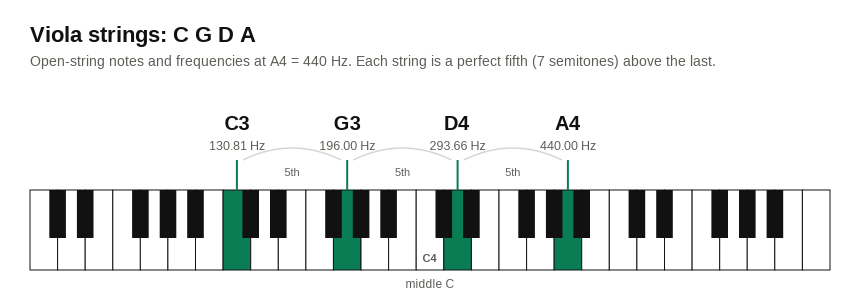
| String | Note | A4 = 440 Hz | A4 = 442 Hz | Pure fifths (from A 440) |
|---|---|---|---|---|
| 4th (lowest) | C3 | 130.81 Hz | 131.41 Hz | 130.37 Hz |
| 3rd | G3 | 196.00 Hz | 196.89 Hz | 195.56 Hz |
| 2nd | D4 | 293.66 Hz | 295.00 Hz | 293.33 Hz |
| 1st (highest) | A4 | 440.00 Hz | 442.00 Hz | 440.00 Hz |
A handy way to remember the order is “Cats Go Dancing Around”. Viola music is written mostly in the alto clef, where the middle line is middle C, a quick check that the open C string sits an octave below it.
How to tune a viola step by step
1. Tune the A string first
A is the reference pitch for every string player. Get it right first; the other three strings are tuned from it, and it’s the note your teacher or orchestra will give.
2. Use fine tuners for small corrections
Fine tuners are the small screws on the tailpiece. Many violas have one on the A string, and student instruments often have one on every string. Turning clockwise raises the pitch and counterclockwise lowers it. They’re ideal when the tuner shows the string within about 20–30 cents.
3. Use the pegs for bigger changes
For anything more than a quarter tone, turn the peg in small movements while pressing it gently into the pegbox so it grips. Bring the string up to pitch from slightly below; that helps the peg hold and the string settle.
4. Tune D, then G, then C
Work down from A. The low C string is thick and reacts slowly, so give it a moment after each turn and bow again before reading the needle. Finish by checking all four strings once more, since changing one string slightly shifts the tension on the others.
5. Look at the bridge
Tuning gradually pulls the top of the bridge toward the fingerboard. After a big retune or new strings, check from the side that the bridge still stands straight. If it leans, ease it back carefully or ask your teacher or a luthier.
Equal temperament or pure fifths on the viola
By default this tuner uses equal temperament, the system pianos are tuned in. Violists who tune by ear usually tune pure fifths, where two neighbouring open strings ring together without any beating. A pure fifth is about 2 cents wider than an equal-tempered one, and across three fifths that adds up: tuning down from A, the D is 2 cents lower, the G 4 cents lower and the C almost 6 cents lower than on a piano.
Choose Pure fifths (from A) under Tuning for solo playing, quartets and string orchestra. With piano, many violists prefer equal temperament or tune the fifths slightly narrow so the open C doesn’t sound flat against the keyboard.
How to tune a viola by ear
After the A is in tune, bow the A and D strings together as a double stop. An out-of-tune fifth produces a quick wobble or beating; adjust the D until the sound becomes smooth and still. Then pair D with G, and G with C. It takes practice to hear, and this tuner is a good way to check how close your ear got.
Tips for accurate readings
- One open string at a time. Let the previous string stop ringing before playing the next.
- Steady bow, medium volume. Scratchy or very soft tone makes the needle jump. Pizzicato works too, but fades quickly.
- Move closer for the C string. Small phone microphones pick up low notes less strongly.
- Read after the attack. The first moment of a bow stroke is slightly sharp; wait for the tone to settle.
- Quiet room. Fans, air conditioning and other instruments make readings less stable.
Why your viola goes out of tune
New strings keep stretching for several days, so expect to retune often after a string change. Temperature and humidity changes move both the wood and the strings; a viola carried from a cold car into a warm room will drift. Slipping pegs usually mean the peg wasn’t pressed in while turning, or that it needs refitting by a luthier.
Choosing the reference pitch
A4 = 440 Hz is the standard for lessons, practice and playing along with piano or recordings. Orchestras often tune a little higher, at 442 or 443 Hz, and Baroque groups commonly use 415 Hz. Pick your ensemble’s pitch from the Reference pitch menu and the tuner remembers it on this device. For a sustained drone at any frequency, try our online tone generator.
Frequently asked questions
What are the notes of the viola strings?
From lowest to highest, a viola is tuned C3, G3, D4 and A4. At standard pitch (A4 = 440 Hz) their frequencies are 130.81 Hz, 196.00 Hz, 293.66 Hz and 440.00 Hz. The strings are a perfect fifth apart: the same notes as a cello, one octave higher.
How is viola tuning different from violin tuning?
A viola has a low C string instead of the violin’s high E string. Its G, D and A strings are the same pitches as the violin’s G, D and A, so the viola is tuned a perfect fifth lower overall: C G D A instead of G D A E.
Which viola string should I tune first?
Tune the A string first, because it is the reference pitch an orchestra or teacher gives. Then tune D, G and finally the low C string, and check all four once more at the end.
Can I use a violin tuner for my viola?
A violin tuner will handle the viola’s G, D and A strings, which share the same pitches, but it has no setting for the low C string. A viola tuner, or any chromatic tuner, covers all four strings.
Should a viola be tuned to 440 or 442 Hz?
Use 440 Hz for practice, lessons and playing with piano or recordings. Many orchestras tune to 442 or 443 Hz, so match the pitch your ensemble uses.
Why does my viola C string sound flat against the piano?
If you tune by ear in pure fifths from A, the C string ends up about 6 cents lower than the piano’s equal-tempered C. That is normal for solo and string-ensemble playing; with piano, many violists tune the fifths slightly narrow or use equal temperament.
Can I tune a viola with my phone?
Yes. This tuner works with any phone, tablet or laptop microphone. Hold the device about 30 to 60 cm from the viola, play one open string at a time and keep the room quiet.