How to use the banjo tuner
- Press Start tuning and allow microphone access. Hold your phone or laptop near the banjo head.
- Choose your tuning in the Tuning menu. Open G is the standard for 5-string banjo.
- Pick one open string and let it ring. The tuner finds the string and moves the needle.
- Needle left means flat: tighten the string. Needle right means sharp: loosen it. When the note turns green the string is in tune and gets a green dot.
Standard banjo tuning: open G (gDGBD)
Most 5-string banjos are tuned to open G. Strummed open, the strings sound a G major chord, which is why so much bluegrass is played in G. The string order surprises guitarists: the 5th string is a short drone string that starts at the fifth fret and is the highest note, written as a lowercase g.
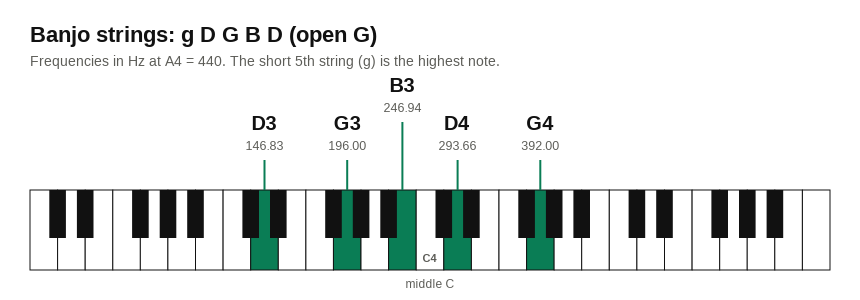
| String | Note | Frequency (A4 = 440 Hz) |
|---|---|---|
| 5th (short drone) | G4 | 392.00 Hz |
| 4th | D3 | 146.83 Hz |
| 3rd | G3 | 196.00 Hz |
| 2nd | B3 | 246.94 Hz |
| 1st | D4 | 293.66 Hz |
Other banjo tunings
| Tuning | Notes (5th → 1st) | Used for |
|---|---|---|
| Double C | g C G C D | Clawhammer and old-time tunes in C and D |
| Drop C (C tuning) | g C G B D | Classic and Scruggs-style tunes in C |
| Open D | f♯ D F♯ A D | Tunes in D, such as “Reuben” |
| Tenor banjo | C G D A (4 strings) | Dixieland and jazz rhythm |
| Irish tenor banjo | G D A E (4 strings) | Irish traditional music, an octave below a fiddle |
Switching from open G to double C takes two changes: lower the 4th string from D to C and raise the 2nd string from B to C. For drop C, only the 4th string drops to C.
How to tune a banjo step by step
- Check the bridge. The banjo bridge floats, held only by string pressure. Make sure it hasn’t slid or tilted; its position sets the intonation.
- Tune the 3rd string (G) first, then the 4th, 2nd and 1st. The 5th string goes last.
- Turn the tuners slowly. Many banjos use planetary tuners with a gear ratio, so a small turn makes a small change. Come up to the note from below.
- Mind the 5th string peg. It sits on the side of the neck at the fifth fret. Turn gently; the thin string breaks easily.
- Recheck everything. Tightening one string slightly changes the head tension and the others.
How to tune a banjo by ear
With the 3rd string (G) in tune, use frets to tune the rest in open G:
- 4th string at the 5th fret matches the open 3rd string (G).
- 3rd string at the 4th fret matches the open 2nd string (B).
- 2nd string at the 3rd fret matches the open 1st string (D).
- 1st string at the 5th fret matches the open 5th string (g).
Why banjos drift out of tune
A banjo is part drum. Its head reacts to temperature and humidity, which changes the tension under the bridge and the pitch of every string. New strings stretch for a few days, and a moved bridge throws off intonation even when open strings read in tune. Keep the head tension even, store the banjo in its case away from heat, and retune before each session.
Tips for accurate readings
- Pick, don’t strum. One string at a time; mute the rest with your hand.
- Let it ring. Banjo notes decay fast; pick firmly and read the needle just after the attack.
- Get close to the head. A banjo is loud, but the tuner still needs a clean signal over room noise.
Frequently asked questions
What is standard banjo tuning?
The standard tuning for a 5-string banjo is open G: g D G B D. From the short 5th string to the 1st string the notes are G4 (392.00 Hz), D3 (146.83 Hz), G3 (196.00 Hz), B3 (246.94 Hz) and D4 (293.66 Hz). Strumming the open strings plays a G major chord.
Why is the 5th string of a banjo so high?
The 5th string is a short drone string that starts at the fifth fret. In open G tuning it is tuned to G4, higher than all the other open strings. It is played with the thumb in bluegrass and clawhammer styles to give the banjo its ringing drone.
What is double C tuning on a banjo?
Double C tuning is g C G C D (G4, C3, G3, C4, D4). It is popular in clawhammer and old-time music. From open G, lower the 4th string from D to C and raise the 2nd string from B to C.
How do I tune a tenor banjo?
A standard 4-string tenor banjo is tuned C G D A (C3, G3, D4, A4), in fifths like a viola. Irish tenor banjo is tuned G D A E (G2, D3, A3, E4), an octave below a fiddle. Choose either in this tuner’s Tuning menu.
Why does my banjo go out of tune so quickly?
Banjos have a drum-like head and a floating bridge, so changes in temperature and humidity affect the head tension and the pitch. New strings also stretch for a few days. Check that the bridge has not moved, keep the head tension even, and retune before each session.
Can I tune my banjo with my phone?
Yes. This tuner runs in your phone or computer browser with no app to install. Hold the device near the head of the banjo, pick one string at a time and let it ring.