How to find your vocal range
- Warm up for a minute or two: gentle humming, lip trills or sirens. Cold voices lose several notes at both ends.
- Press Start the vocal range test and allow microphone access. A quiet room gives the most reliable result.
- Lowest note: sing a note on an open “ah” at a comfortable pitch, then slide slowly down. Hold your lowest comfortable note for a moment. Ignore growls and vocal fry; they aren’t usable singing notes.
- Highest note: start comfortably again and slide slowly up, letting your voice flip into head voice or falsetto if it wants to. Hold your highest clear note without straining.
- Read your result: your lowest and highest notes, how many octaves that spans, and the voice type it matches best.
How the vocal range test works
The test measures the pitch of your voice dozens of times per second in real time. It uses the same pitch detection engine as our pitch detector, built on the browser’s Web Audio API, so it runs entirely on your device. A note only counts once you’ve held it steadily, within 40 cents of the note center, for about a fifth of a second. That filters out the quick slides between notes, cracks and accidental squeaks that would otherwise exaggerate your range.
Once you have a lowest and highest note, the test calculates your range in semitones and octaves and converts it to frequency in hertz. It then compares your range with the typical ranges for each voice type, weighting your lowest note a little more heavily. Low notes depend mainly on the physical size of your vocal folds and are a more reliable indicator of voice type than top notes, which grow with training.
Vocal range chart: the six main voice types
Classical singing groups voices into six main types: three female (soprano, mezzo-soprano, alto) and three male (tenor, baritone, bass). The soprano, alto, tenor and bass parts are the four voices of a standard choir (SATB). The ranges below are typical for trained singers; it’s completely normal to fall between categories or to have a few notes more or less.
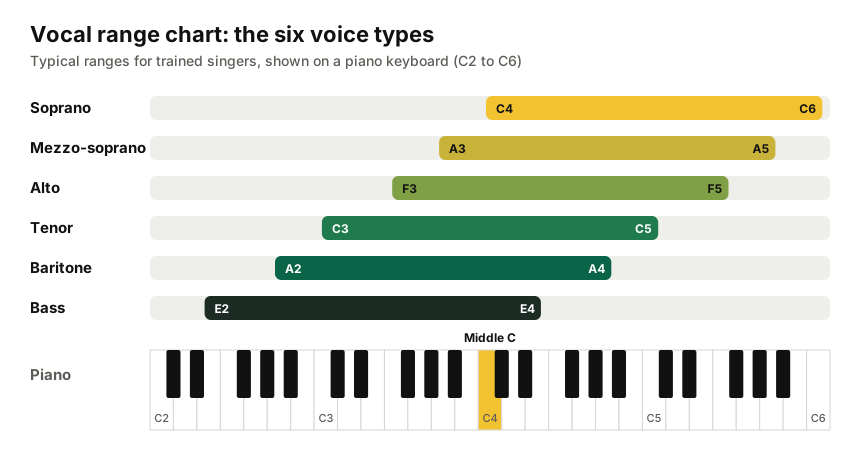
| Voice type | Typical range | Frequency | Character |
|---|---|---|---|
| Soprano | C4 – C6 | 262 – 1047 Hz | Bright, high female or treble voice |
| Mezzo-soprano | A3 – A5 | 220 – 880 Hz | Middle female voice, warmer than soprano |
| Alto (contralto) | F3 – F5 | 175 – 698 Hz | Lowest female voice, rich and dark |
| Tenor | C3 – C5 | 131 – 523 Hz | Highest common male voice |
| Baritone | A2 – A4 | 110 – 440 Hz | Most common male voice |
| Bass | E2 – E4 | 82 – 330 Hz | Lowest male voice |
Female voice types
Soprano is the highest female voice, usually comfortable up to A5 or higher. Mezzo-soprano sits in the middle, with a warmer color and a strong range around C4–C5. Alto (contralto in opera) is the lowest female voice and the rarest true classical type, with rich low notes down to F3 or below. Many pop singers with a strong chest voice are mezzos or altos.
Male voice types
Tenor is the highest common male voice, with a bright top around G4–C5. Baritone is the most common male voice, sitting between tenor and bass. Bass is the lowest voice, with deep, resonant notes and a comfortable range of roughly E2 to E4. Countertenors, men who sing mostly in a developed falsetto in the alto range, are a specialized seventh category.
Vocal range vs. voice type
Your vocal range is simply all the notes you can sing, from lowest to highest. Your voice type describes where your voice naturally sits and sounds best, called your tessitura, plus its tone color and where your register breaks fall. Two singers can have nearly identical ranges and still be different voice types: a baritone and a tenor might both reach G4, but the tenor sings there comfortably for a whole song while the baritone visits it briefly.
That’s why this test reports the voice type your range is closest to, along with a second option. To find your true voice type, notice where singing feels easiest and sounds fullest, and ideally check with a vocal coach, who will also listen to timbre, weight and where you switch between chest voice and head voice.
“What is my vocal range?” Reading your result
If you’ve ever wondered “how do I find my vocal range?”, this online vocal range test is the quickest way to get an answer. Your result shows your lowest and highest comfortable notes in scientific pitch notation, where middle C is C4. A result of A2 – F4, for example, means you can sing from the A almost two octaves below middle C up to the F above it. That’s 1 octave + 8 semitones, a typical baritone range. The voice type test then highlights your range on the chart against all six voice types, so you can see at a glance which one it overlaps most.
If your highest note came from falsetto, you can retake the voice range test with your chest voice only to see where your full voice tops out. Both numbers are useful: total range for knowing what you can reach, and chest-voice range for choosing song keys.
What is a good vocal range?
Most untrained adults can sing about 1.5 to 2 octaves. With training, 2 to 3 octaves is common, and a handful of famous singers are known for ranges of four octaves or more, though that usually includes extreme registers like whistle tone and vocal fry. You don’t need a huge range to sing well: most popular songs use little more than an octave, and choosing songs in the right key matters far more than adding notes at the extremes.
How to expand your vocal range safely
- Warm up every time with lip trills, humming and sirens before you sing your highest notes.
- Work on breath support. Steady airflow from the diaphragm and lower ribs stabilizes high and low notes.
- Smooth your register breaks. Practice slow sirens through the passaggio so chest voice and head voice blend.
- Extend gradually. Add one half step at a time at the edges of the notes you can sing comfortably.
- Stay hydrated and rest when your voice feels tired or hoarse. Pain is a signal to stop.
Retake the test every few weeks to track your progress. Use the What Note Am I Singing tool to practice landing precisely on new notes at the top and bottom of your range.
Tips for an accurate result
- Test in a quiet room without music, TV or fans. Background noise can be mistaken for notes.
- Use an open “ah” or “oh” vowel. Closed sounds like “ee” and humming can make low notes harder to detect.
- Keep the microphone 10–30 cm (4–12 in) from your mouth. Built-in laptop and phone mics work fine.
- Take the test two or three times on different days. Your voice is usually lower in the morning and higher after warming up.
Frequently asked questions
How does the vocal range test work?
You sing your lowest comfortable note and then your highest comfortable note into your microphone. Real-time pitch detection identifies each note you hold for at least a fifth of a second, keeps the lowest and highest, and compares your range with the typical ranges of each voice type.
What is a good vocal range?
Most untrained adults can sing about 1.5 to 2 octaves. Trained singers commonly reach 2 to 3 octaves, and a few exceptional voices go beyond that. A wider range isn’t automatically better: tone, control and how well you use the notes you have matter more.
Can my vocal range increase?
Yes, usually by a few notes, mostly at the top. Regular warm-ups, good breath support and smoothing the transition into head voice extend your usable range. Your lowest notes are set mostly by the size of your vocal folds and change less.
Does falsetto count in my vocal range?
For a total range, yes: falsetto and head voice are part of what you can sing. For voice type, singers and vocal coaches care more about the notes you can sing comfortably in your full voice, so note where your chest voice ends as well.
Why is my result different each time?
Your range changes with warm-up, time of day, hydration and fatigue. Voices are usually lower in the morning and reach higher after a good warm-up. Take the test two or three times and use the range you can repeat.
Is the vocal range test accurate?
The note detection itself is accurate to a few cents. The voice type is an estimate based on range only. A vocal coach also listens to tone color, where your voice is most comfortable (tessitura) and where your register breaks fall to determine your true voice type.