How to take the voice Hz test
- Find a quiet room. Background noise such as TV, music or fans can add false readings.
- Press Start the voice test and allow microphone access when your browser asks.
- Read the passage aloud at your normal conversational volume and pace, the way you’d talk to a friend.
- After 20 seconds (or when you press Finish now), the test shows your average pitch in Hz, the closest musical note, and where your voice sits compared with typical adult voices.
What the voice test measures
When you talk, your vocal folds open and close many times per second. That rate is the fundamental frequency (F0) of your voice, measured in hertz: a voice at 120 Hz has vocal folds vibrating 120 times a second. Listeners hear F0 as the pitch of your voice: lower F0 sounds deeper, higher F0 sounds lighter.
Speech constantly moves up and down in pitch, so the test measures F0 about 60 times per second in real time and builds a picture of your whole sample. It reports the median as your average speaking pitch, because the median isn’t thrown off by a few unusually high or low moments. The typical range covers the middle 80% of your speech, and the histogram shows how your pitch was distributed. Readings that jump by an octave, a common glitch with creaky or breathy speech, are filtered out automatically.
The tests run entirely in your browser with the Web Audio API and the same pitch detection engine as our pitch detector. Your audio never leaves your device.
Average voice frequency chart
These ranges are commonly cited in speech science for the average speaking F0 of healthy voices. They overlap, and plenty of people fall outside them. A result outside a range isn’t a problem; it’s just a measurement.
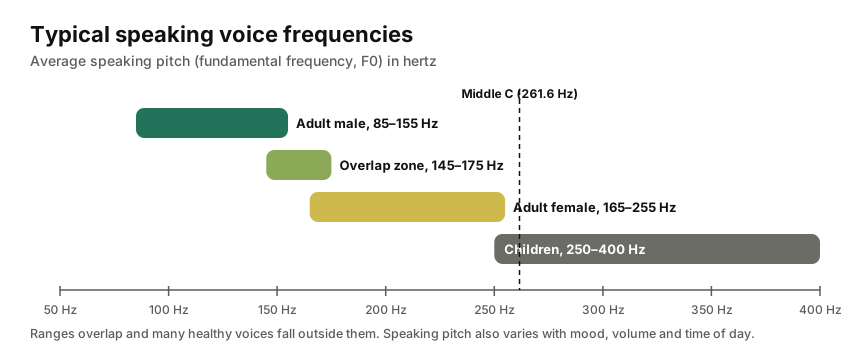
| Group | Typical speaking pitch | Rough average | Nearest notes |
|---|---|---|---|
| Adult male voices | 85–155 Hz | ~120 Hz | F2 – D♯3 |
| Overlap / gender-neutral zone | 145–175 Hz | ~160 Hz | D3 – F3 |
| Adult female voices | 165–255 Hz | ~210 Hz | E3 – C4 |
| Children (before puberty) | 250–400 Hz | ~300 Hz | B3 – G4 |
A speaking pitch around 180 Hz, for example, is close to the F♯3 piano key. For comparison, middle C (C4) is 261.6 Hz, so most adult speaking voices sit below middle C, roughly in the lower third of the notes you can sing.
The “voicecel test” and voice pitch myths
On TikTok and other social platforms, measuring your voice in Hz became a trend under names like voicecel test, deep voice test or voice pitch test, usually with claims that a lower number is “better”. Technically, a voicecel test is exactly what this page measures: the average fundamental frequency of your speaking voice.
But pitch alone says much less than the trend suggests. How a voice comes across depends heavily on resonance (how sound is shaped in your throat and mouth), intonation (how pitch moves across a sentence), pace, clarity and confidence. A voice at 130 Hz can sound thin and a voice at 160 Hz can sound rich and full. Speaking pitch also shifts with mood, volume and fatigue throughout the day. Treat your number as an interesting measurement, not a score.
Who uses a voice pitch test?
Voice training
People doing voice training, including gender-affirming voice training, use F0 measurements to track progress toward a target pitch range. It works best alongside resonance and intonation work, ideally with a speech-language pathologist or experienced voice coach.
Public speaking and presenting
Speakers check whether nerves push their pitch up, and whether their typical range is varied enough to sound engaging rather than monotone.
Singers
Your speaking pitch hints at your voice type: it usually sits near the lower part of your singing range. For the full picture, use our vocal range test to find your lowest and highest notes. It will tell you whether you’re closer to a bass, baritone, tenor, alto, mezzo-soprano or soprano.
Health and vocal changes
Pitch naturally changes with age: voices drop during puberty, many women’s voices lower slightly after menopause, and men’s voices often rise a little in older age. A sudden or lasting change in your voice, especially with hoarseness, is worth checking with a doctor. This tool isn’t a medical device.
Why your voice Hz changes from test to test
- Time of day: voices tend to be lower in the morning and rise slightly as the day goes on.
- Volume and emotion: louder, excited or nervous speech is higher.
- What you read: questions and exclamations rise in pitch; calm statements fall.
- Health: colds, allergies and a tired voice usually lower your pitch temporarily.
- Microphone and room: heavy background noise or a muffled mic can lower accuracy.
For a stable baseline, take the test three times at a similar time of day and compare the medians.
Speaking pitch vs. singing notes
Speaking and singing use the same vocal folds, but speech glides continuously while singing holds steady notes. If you want to see the exact note you’re singing, sing a sustained note on an open “ah” into our What Note Am I Singing tool. To find your vocal range, meaning the lowest and highest notes you can sing comfortably, use the vocal range test.
Frequently asked questions
What is a normal voice frequency in Hz?
Typical adult male speaking voices average around 85–155 Hz, and typical adult female voices around 165–255 Hz. Children usually speak higher, often 250 Hz and above. There is natural overlap, and many healthy voices fall outside these ranges.
What does the voice Hz test measure?
It measures the fundamental frequency (F0) of your voice, the rate at which your vocal folds vibrate, many times per second while you read. It reports the median as your average pitch, plus the range covering the middle 80% of your speech.
What is the voicecel test?
“Voicecel test” is a name that spread on social media for measuring how deep your speaking voice is in hertz. Technically it is the same measurement as this voice Hz test. Pitch is only one part of how a voice sounds; resonance, intonation, clarity and confidence matter as much.
Why is my voice Hz different every time?
Speaking pitch varies with mood, energy, volume, time of day and what you read. Excited or loud speech is higher; tired morning speech is lower. Take the test two or three times and compare the median values.
Is my voice recorded?
No. The test runs entirely in your browser using the Web Audio API. Your voice is analyzed in real time and is never recorded, stored or uploaded.
How is speaking pitch different from vocal range?
Speaking pitch is where your voice sits in normal conversation, usually near the bottom third of your range. Your vocal range is every note you can sing, from lowest to highest. Use the vocal range test to measure that.