How to use the chromatic tuner
- Press Start listening and allow microphone access.
- Playing a transposing instrument? Set Instrument key to B♭, E♭ or F so the tuner shows your written notes.
- Play one sustained note. The tuner shows the nearest note, its frequency and a needle for the pitch.
- Needle left of center means flat, right means sharp. Adjust until the needle sits in the green zone and the note turns green: in tune.
What is a chromatic tuner?
A chromatic tuner recognises every note of the chromatic scale, all 12 semitones from C to B, in any octave. Instead of comparing you with a fixed set of target strings, it names whatever note you play and measures how far you are from it in cents. That’s why one chromatic tuner can tune a guitar in drop D, a trumpet, a flute, a harp or a singer.
Under the hood, the tuner analyses your microphone signal about 50 times per second, finds its fundamental frequency, and maps it to the nearest note of equal temperament based on your reference pitch (A4 = 440 Hz by default).
Reading the needle: cents sharp and flat
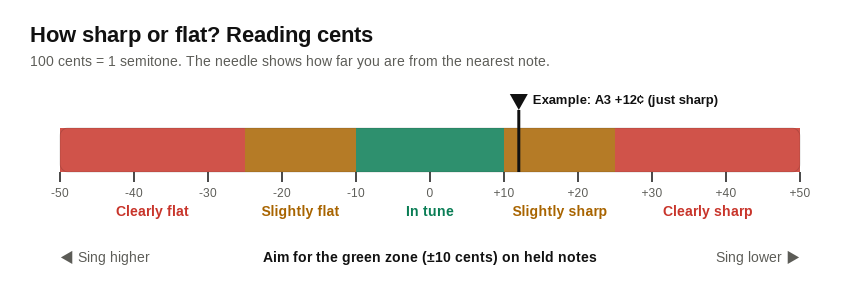
A cent is one hundredth of a semitone. At 0 cents you’re exactly on the note. Up to about ±5 cents sounds in tune to most listeners; beyond 10 cents most people hear it as out of tune, especially in chords. If you’re more than 50 cents away, the tuner switches to the neighbouring note.
Transposing instruments: B♭, E♭ and F
Many wind and brass instruments are transposing instruments: the note you read and finger is not the note that sounds. A plain chromatic tuner always shows the sounding (concert) pitch, which confuses players. Choose your instrument’s key and this tuner shows the written note instead, with the concert pitch alongside.
| Instrument key | Instruments | Written C sounds as |
|---|---|---|
| C (concert) | Flute, oboe, bassoon, trombone, tuba, piano, strings, voice | C |
| B♭ | Clarinet, trumpet, cornet, soprano sax | B♭ a whole tone lower |
| B♭ (octave lower) | Tenor sax, bass clarinet | B♭ a major ninth lower |
| E♭ | Alto sax, E♭ clarinet | E♭ a major sixth lower |
| E♭ (octave lower) | Baritone sax | E♭ an octave and a major sixth lower |
| F | French horn, English horn | F a perfect fifth lower |
Prefer a tuner set up for your instrument? Try the flute, clarinet, saxophone, trumpet or trombone tuner. Each opens in the right key with tips for that instrument.
Which instruments can you tune?
Guitar and bass, any tuning
Standard, drop D, open G, DADGAD or half-step down: play each open string and turn the peg until the tuner shows the note you want, centred. A chromatic tuner doesn’t care which tuning you choose.
Wind and brass instruments
Warm up for a few minutes first, because a cold instrument plays flat. Tune on a comfortable middle-register note, then adjust the mouthpiece, barrel, slide or crook. Check a few notes across the range; some notes on every wind instrument naturally lean sharp or flat and need lipping.
Harp, mandolin, banjo and other string instruments
Pluck one string at a time and let it ring. For instruments with many strings, tune the reference notes first, then work outward.
Voice and ear training
Singers can use a chromatic tuner to check intonation on sustained notes. For a guided exercise with a target note, try What Note Am I Singing, or use the note detector with its pitch-over-time graph.
Tips for accurate tuning
- One note at a time. Chords and ringing open strings confuse any tuner; mute other strings.
- Steady tone, medium volume. The start of a note is often sharp; read the needle once the note settles.
- Quiet room, close mic. Move your phone or laptop closer if the reading jumps.
- Lower the mic sensitivity in a noisy room so background sound isn’t detected as notes.
- Match your group’s reference pitch. Change A4 to 442 Hz or 443 Hz for orchestras that tune higher.
Online tuner vs clip-on and pedal tuners
Clip-on tuners read vibrations through the instrument, so they work well in noisy rooms but only for instruments they can clip to. Pedal and strobe tuners are the most precise but cost money and sit on the floor. An online chromatic tuner needs nothing but a browser and microphone, which makes it ideal for practice at home, lessons and quick checks, and it works on any instrument, including voice and wind.
Frequently asked questions
What is a chromatic tuner?
A chromatic tuner recognises all 12 notes of the chromatic scale (C, C♯, D … B) in every octave, rather than only the open strings of one instrument. It shows the nearest note and how many cents sharp or flat you are, so it works for any instrument and any tuning.
What is the difference between a chromatic tuner and a guitar tuner?
A guitar or instrument tuner is set up for specific target notes, such as E A D G B E, and tells you which string you are near. A chromatic tuner simply names whatever note you play. That makes it the right choice for alternate tunings, wind and brass instruments, voice and checking individual notes.
How do I tune a B♭ instrument with a chromatic tuner?
Set Instrument key to B♭. The tuner then shows your written note: when a clarinet or trumpet plays a written C, the tuner shows C instead of the concert B♭ it actually sounds. The concert pitch is shown next to the cents reading.
What does cents mean on a tuner?
A cent is one hundredth of a semitone. If the tuner shows +10 cents you are slightly sharp; −10 cents is slightly flat. Most listeners notice differences of about 5 to 10 cents, so aim to stay within about ±5 cents.
Is an online chromatic tuner accurate?
Yes. This tuner measures the fundamental frequency many times per second and is accurate to about a cent with a clean, steady tone. Accuracy drops with background noise, very quiet playing, or several notes sounding at once.
Should I tune to 440 or 442 Hz?
440 Hz is the international standard and right for most practice and bands. Many orchestras tune to 442 or 443 Hz. Set the Reference pitch to match your group.