How to use the ukulele tuner
- Press Start tuning and allow microphone access. Hold your phone or laptop close to the ukulele’s sound hole.
- Pick your tuning in the Tuning menu: Standard GCEA fits soprano, concert and tenor ukuleles.
- Pluck one open string and let it ring. The tuner detects which string it is and moves the needle.
- Needle left of center means flat: tighten the string. Right of center means sharp: loosen it. When the note turns green, the string is in tune and gets a green dot.
Standard ukulele tuning: G C E A
Soprano, concert and tenor ukuleles are tuned G C E A. Counting the way players do, the 4th string (top, nearest your chin) is G, then C, E, and the 1st string (bottom) is A. Strum all four open strings and you’ll hear a C6 chord, the familiar “My Dog Has Fleas” sound.
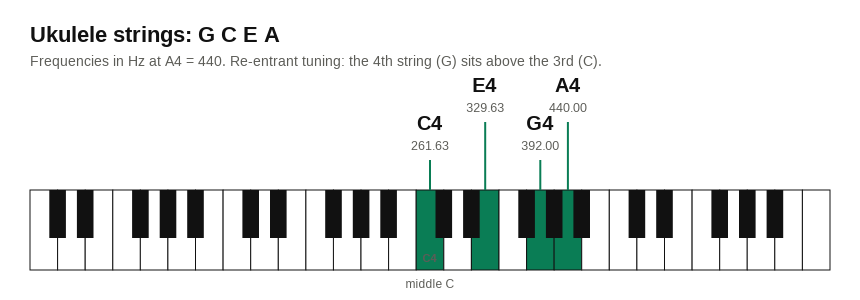
The surprise for new players is that the G string is higher than the C string. This is called re-entrant tuning: the 4th string “re-enters” above the 3rd instead of being the lowest note. It keeps every string within a narrow range, which is what makes ukulele chords sound bright and close.
Ukulele string notes and frequencies
| Tuning | 4th string | 3rd string | 2nd string | 1st string |
|---|---|---|---|---|
| Standard (soprano, concert, tenor) | G4 392.00 Hz | C4 261.63 Hz | E4 329.63 Hz | A4 440.00 Hz |
| Low G | G3 196.00 Hz | C4 261.63 Hz | E4 329.63 Hz | A4 440.00 Hz |
| Baritone | D3 146.83 Hz | G3 196.00 Hz | B3 246.94 Hz | E4 329.63 Hz |
| D tuning (traditional) | A4 440.00 Hz | D4 293.66 Hz | F♯4 369.99 Hz | B4 493.88 Hz |
All frequencies are at standard pitch, A4 = 440 Hz. If you play with a group tuned slightly higher or lower, change Reference pitch and every target moves with it.
Which tuning does your ukulele need?
Soprano, concert and tenor: standard GCEA
The three most common sizes share the same tuning. Larger bodies sound fuller and have more room between frets, but the notes are identical, so the same chord charts work on all three.
Low G
Many tenor players swap the high G for a thicker low G string, tuned an octave down to G3. It adds bass notes for fingerstyle and solo playing. You need a low G string for this; don’t tune a standard G string down an octave, it will be too slack to play.
Baritone: DGBE
The baritone ukulele is tuned D G B E, like the top four strings of a guitar, and it isn’t re-entrant. Chord shapes match guitar shapes, but the chord names differ from standard ukulele.
D tuning: ADF♯B
The older “D tuning” is a whole tone higher than standard. You’ll find it in vintage songbooks and some Hawaiian and British repertoire, often on soprano ukuleles.
How to tune a ukulele step by step
- Start with any string; each one is tuned to the tuner independently. Many players go from the 4th string (G) to the 1st (A).
- Pluck firmly and let it ring. Read the needle after the first pluck’s attack has settled.
- Turn the peg slowly while the string rings and watch which way the needle moves. Tightening raises the pitch; loosening lowers it. Ukulele pegs on either side of the headstock turn in opposite directions, so let the needle tell you.
- Come up to the note from below. If you overshoot, loosen a little past the note and tighten back up; the string holds pitch better that way.
- Check all four strings again. Tuning one string slightly changes the tension on the neck and the others.
How to tune a ukulele without a tuner
Once one string is right, you can tune the others to it by ear using frets (standard tuning):
- Press the C string at the 4th fret: it should match the open E string.
- Press the E string at the 5th fret: it should match the open A string.
- Press the C string at the 7th fret: it should match the open G string (re-entrant G).
When two matching notes are slightly apart you’ll hear a wobble; adjust until it disappears. If you have no starting note, use this tuner’s Play reference tone or our tone generator.
Why your ukulele keeps going out of tune
- New strings stretch. Nylon and fluorocarbon ukulele strings stretch far more than steel guitar strings, often for one to two weeks. Tune, gently pull each string away from the fretboard along its length, then tune again. Repeat until it holds.
- Temperature and humidity. Moving between a cold car and a warm room, or playing under hot lights, shifts the pitch quickly.
- Friction pegs. Many sopranos have friction tuners; tighten the small screw on the end of the peg slightly if it slips back.
- Intonation. If open strings are in tune but chords higher up sound off, the problem is the instrument’s setup, not tuning. A music shop can check the nut and saddle.
Tips for accurate readings
- One string at a time. Mute the others with your hand so they don’t ring in sympathy.
- Pluck with your thumb or a soft pick at medium volume; very hard plucks start sharp.
- Get close. Ukuleles are quiet; hold the phone near the sound hole, especially in a noisy room.
- Low G and baritone strings are deeper, so give them a firmer pluck for a steady reading.
Frequently asked questions
What are the notes of the ukulele strings?
Standard ukulele tuning is G C E A, from the string closest to your chin (4th) to the one closest to the floor (1st): G4 (392.00 Hz), C4 (261.63 Hz), E4 (329.63 Hz) and A4 (440.00 Hz). Soprano, concert and tenor ukuleles all use this tuning.
Why is the G string higher than the C string?
Standard ukulele tuning is re-entrant: the 4th string is tuned to the G above middle C instead of the G below it. That gives the ukulele its bright, sparkly chord sound. Low G tuning uses a thicker string tuned an octave lower, to G3, for a fuller range.
How do I tune a baritone ukulele?
A baritone ukulele is tuned D G B E (D3, G3, B3, E4), the same as the four highest strings of a guitar. Choose Baritone (DGBE) in this tuner’s Tuning menu.
Why won’t my ukulele stay in tune?
New nylon or fluorocarbon strings stretch a lot and can take one to two weeks to settle, so a new ukulele drifts flat constantly at first. Retune often, and gently pull each string away from the fretboard to speed up stretching. Temperature and humidity changes also shift the pitch.
Which way do I turn the tuning peg?
It depends on the side of the headstock, so check with the tuner: turn the peg a little while the string rings and watch the needle. If the needle moves toward the center, keep going. Tightening the string raises the pitch; loosening lowers it.
What is My Dog Has Fleas?
“My Dog Has Fleas” is the classic phrase for remembering the sound of the four open ukulele strings in standard tuning, G C E A, sung on the notes as you strum each string from the 4th to the 1st.
Can I tune my ukulele with my phone?
Yes. This tuner works with any phone, tablet or laptop microphone, in the browser, with no app to install. Hold the device close to the sound hole, pluck one string at a time and keep the room quiet.