How to use the cello tuner
- Press Start tuning and allow microphone access. Place your phone or laptop about 30–60 cm (1–2 feet) in front of the cello, near the f-holes.
- Sit in your normal playing position and bow the open A string with a full, steady stroke. The tuner detects the string and shows its frequency.
- Needle left of center means the string is flat (too low): tighten it. Needle right of center means sharp (too high): loosen it.
- When the needle settles in the green zone the string is in tune and gets a green dot. Repeat for D, G and C.
Standard cello tuning: C G D A
The cello’s four strings are tuned in perfect fifths: C2, G2, D3 and A3, from the thickest to the thinnest string. That’s the same four notes as a viola, one octave lower. The open C string is the lowest note of the cello, two octaves below middle C.
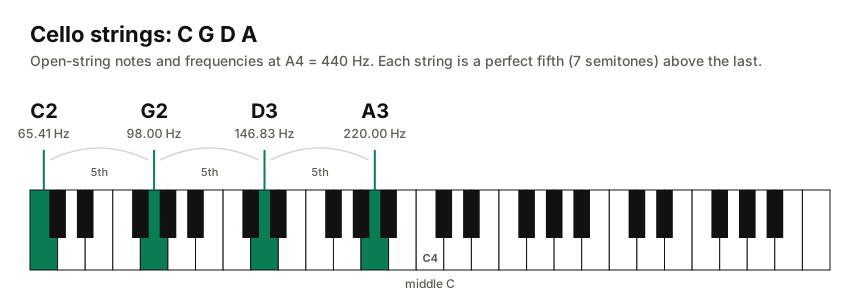
| String | Note | A4 = 440 Hz | A4 = 442 Hz | Pure fifths (from A 220) |
|---|---|---|---|---|
| 4th (lowest) | C2 | 65.41 Hz | 65.70 Hz | 65.19 Hz |
| 3rd | G2 | 98.00 Hz | 98.44 Hz | 97.78 Hz |
| 2nd | D3 | 146.83 Hz | 147.50 Hz | 146.67 Hz |
| 1st (highest) | A3 | 220.00 Hz | 221.00 Hz | 220.00 Hz |
A common way to remember the order from low to high is “Cats Go Down Alleys”. Strings are numbered from the highest: A is the 1st string and C is the 4th.
How to tune a cello step by step
1. Tune in playing position
Sit with the cello resting against you and the endpin set as you play. The weight and angle of the instrument slightly change the string tension, so tuning while it lies on its side can leave it out once you sit up.
2. Start with A
Tune the A string first. It’s the reference the ensemble gives, and the other strings are tuned from it. Then tune D, G and C in that order.
3. Fine tuners for small corrections
Fine tuners are the screws on the tailpiece. Most cellos have one on the A string at least, and many have one on every string. Turn clockwise to raise the pitch and counterclockwise to lower it. Use them when the tuner shows the string within about 20–30 cents.
4. Pegs for larger changes
For anything more than a quarter tone, use the peg. Cello pegs are large and hold a lot of tension, so turn in small movements while pressing the peg into the pegbox. Bringing the string up to pitch from slightly below helps the peg grip and the string settle.
5. Give the low strings time
The thick C and G strings react slowly and keep stretching for a while after you turn the peg. Bow the string, wait a few seconds for the reading to settle, and adjust again. Finish by rechecking all four strings and making sure the bridge is still standing straight.
Pure fifths and the cello’s low C
By default this cello tuner uses equal temperament, the same tuning as a piano. Cellists who tune by ear usually tune pure fifths instead, where two neighbouring strings ring together without any beating. Each pure fifth is about 2 cents wider than a tempered one, and on a cello those small differences add up across three fifths: tuning down from A, the C string ends up almost 6 cents lower than the piano’s C.
Choose Pure fifths (from A) under Tuning to tune this way for solo playing and string ensembles. When playing with piano, many cellists use equal temperament, or tune the fifths slightly narrow, so the open C and G match the piano.
How to tune a cello by ear
After tuning the A, bow the A and D strings together as a double stop. An out-of-tune fifth produces a fast “wah-wah” beating; turn the D string until the beating slows and disappears. Then bow D and G together, and G and C. Harmonics help too: the harmonic halfway along one string can be compared with harmonics on the next. Check your result with the tuner to train your ear.
Tips for accurate readings
- Bow with a full, steady stroke at medium volume. Low strings need more bow weight to produce a clear fundamental.
- One string at a time. Let the previous string stop ringing before you play the next one.
- Move the mic closer for C and G. Phone microphones are weak at very low frequencies, so a closer position gives a steadier needle.
- Read after the attack. The start of a bow stroke is slightly sharp; watch the needle once the tone has settled.
- Quiet the room. Air conditioning and other low hums can mask the C string.
Why your cello goes out of tune
New strings stretch for several days, with the C and G taking the longest. Humidity and temperature move the wood and the strings, so a cello carried from a cold car into a warm hall will drift within minutes. Pegs slip when they aren’t pressed in while turning, or when they need refitting. A cello that won’t hold tune even with settled strings is worth showing to a luthier.
Choosing the reference pitch
A4 = 440 Hz (so the cello’s A string is 220 Hz) is the standard for lessons, practice and playing with piano or recordings. Many orchestras tune to 442 or 443 Hz, and Baroque groups often use 415 Hz. Pick the pitch your ensemble uses from the Reference pitch menu and the tuner remembers it on this device. For a sustained drone at any frequency, use our online tone generator.
Frequently asked questions
What are the notes of the cello strings?
From lowest to highest, a cello is tuned C2, G2, D3 and A3. At standard pitch (A4 = 440 Hz) their frequencies are 65.41 Hz, 98.00 Hz, 146.83 Hz and 220.00 Hz. The strings are a perfect fifth apart, exactly one octave below a viola.
Which cello string do you tune first?
Tune the A string first, since it is the reference pitch, then D, G and finally the low C string. Recheck all four at the end, because changing the tension of one string slightly affects the others.
Why does the tuner struggle with my C string?
The C string is very low (about 65 Hz), and small phone and laptop microphones pick up low notes weakly. Bow with a full, steady stroke, hold the device closer to the f-holes, and select the C string manually if automatic detection jumps around.
Should a cello be tuned to 440 or 442 Hz?
Use 440 Hz for practice, lessons and playing with piano or recordings. Many orchestras tune to 442 or 443 Hz, so match whatever pitch your ensemble uses. Then the cello’s A string should read 221 Hz at A4 = 442.
Do fine tuners raise or lower the pitch on a cello?
Turning a fine tuner clockwise tightens the string and raises the pitch; counterclockwise lowers it. Use fine tuners for small corrections and the pegs for changes bigger than about a quarter tone.
Why won’t my cello stay in tune?
New strings keep stretching for days, especially the C and G strings. Changes in humidity and temperature also move the pitch, and pegs slip if they are not pushed in while turning. If a peg will not hold at all, a luthier can refit it.
What is pure-fifths tuning on the cello?
Tuning each pair of neighbouring strings to a beatless 3:2 fifth, the traditional way to tune by ear. Starting from A, the D ends up 2 cents lower, the G 4 cents lower and the C almost 6 cents lower than on a piano. Many cellists narrow the fifths slightly when playing with piano so the C string isn’t noticeably flat.