How to use the violin tuner
- Press Start tuning and allow microphone access. Hold your phone or laptop about 30–60 cm (1–2 feet) from the violin.
- Play the open A string with a steady, medium bow. The tuner detects the string, shows its frequency and moves the needle.
- If the needle is left of center the string is flat (too low): tighten it. If it’s right of center the string is sharp (too high): loosen it.
- When the needle stays in the green zone and the note turns green, the string is in tune and gets a green dot. Repeat for D, G and E.
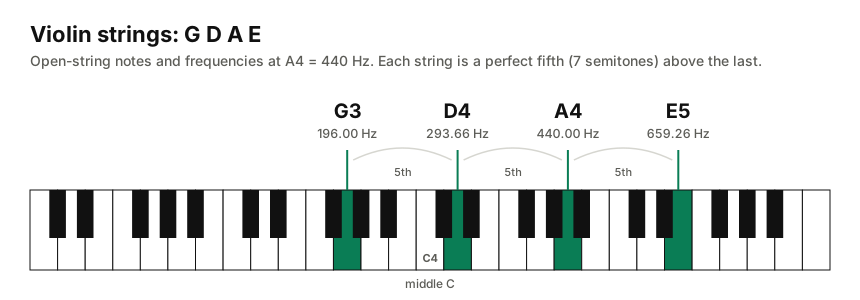
Standard violin tuning: G D A E
A violin has four strings tuned in perfect fifths. From the lowest (thickest) to the highest (thinnest) they are G3, D4, A4 and E5. The A string is the same A above middle C that orchestras tune to, and the G string is the lowest note a violin can play.
| String | Note | A4 = 440 Hz | A4 = 442 Hz | Pure fifths (from A 440) |
|---|---|---|---|---|
| 4th (lowest) | G3 | 196.00 Hz | 196.89 Hz | 195.56 Hz |
| 3rd | D4 | 293.66 Hz | 295.00 Hz | 293.33 Hz |
| 2nd | A4 | 440.00 Hz | 442.00 Hz | 440.00 Hz |
| 1st (highest) | E5 | 659.26 Hz | 662.25 Hz | 660.00 Hz |
A quick way to remember the order is “Good Dogs Always Eat”. Strings are often numbered from the highest: the E string is the 1st string and the G string is the 4th.
How to tune a violin step by step
1. Start with the A string
Always tune A first. It’s the reference for the other three, and it’s the note an orchestra or teacher gives. If the A is badly out, tuning the others first just means redoing them.
2. Fine tuners for small changes
Fine tuners are the small screws on the tailpiece. Most violins have one on the E string, and student violins often have one on every string. Turn clockwise to raise the pitch and counterclockwise to lower it. They are perfect when the tuner shows the string within about 20–30 cents of the target.
3. Pegs for bigger changes
If the string is more than a quarter tone off, or a fine tuner has run out of thread, use the peg in the scroll. Turn it in very small movements while pushing it gently into the pegbox so it grips and doesn’t slip back. Many players lower the string slightly below the note and then come up to it, which helps the peg hold and the string settle.
4. Then D, G and E
Tune D, then G, then E. Tuning changes the tension on the bridge and body, so check all four strings once more at the end. A second pass usually only needs tiny fine-tuner adjustments.
5. Check the bridge
Tightening strings slowly pulls the top of the bridge toward the fingerboard. After a big retune, look at the bridge from the side: it should stand straight, at a right angle to the top of the violin. If it leans, ease it back gently or ask your teacher or a luthier.
Equal temperament or pure fifths?
Most tuners, including this one by default, use equal temperament, the system pianos are tuned in. In equal temperament every fifth is slightly narrow, about 2 cents smaller than a pure fifth.
Violinists traditionally tune by ear to pure fifths instead: when two neighbouring strings ring together, a pure 3:2 fifth sounds calm, with no “beating” or wobble. Stacking pure fifths from A puts the D about 2 cents lower, the G about 4 cents lower and the E about 2 cents higher than equal temperament. Switch Tuning to Pure fifths (from A) to tune your violin this way. For playing with piano, many players prefer equal temperament or split the difference.
How to tune a violin by ear
Once the A is right, you can check the other strings against it without a tuner. Play two neighbouring open strings together as a double stop, for example A and D. If the fifth is out of tune you’ll hear a fast wobble or beating. Adjust the lower string until the beating slows down and disappears. Then do D with G, and A with E. This tuner is useful for checking your ear: tune by ear first, then see how close you got.
Tips for accurate readings
- One string at a time. The tuner reads a single note; double stops and open strings ringing in sympathy can confuse it.
- Bow steadily at medium volume. A scratchy or very soft tone gives a jumpy needle. Plucking (pizzicato) works too, but the note fades quickly.
- Keep the room quiet. Fans, TV and other instruments add noise. In noisy rooms, move the phone closer to the f-holes.
- Wait a moment. The first instant of a bow stroke is slightly sharp. Read the needle once the note has settled.
- Use headphones for the reference tone if you want to listen and measure at the same time, so the tuner doesn’t hear the speaker.
Why your violin goes out of tune
New strings stretch for several days, so expect to retune often after a string change. Temperature and humidity change the wood and the strings; a violin taken from a cold car into a warm room will drift. Slipping pegs usually mean the peg isn’t pushed in while turning, or the pegs need refitting by a luthier. Tune at the start of every practice session; it takes less than a minute with a tuner.
440 Hz, 442 Hz and other reference pitches
A4 = 440 Hz is the international standard and the right choice for lessons, practice and playing along with piano or recordings. Many orchestras, especially in Europe, tune a little higher at 442 or 443 Hz for a brighter sound. Baroque ensembles often use 415 Hz, about a semitone lower. Choose the pitch your group uses from the Reference pitch menu; the tuner remembers it on this device. To hear any exact pitch, use our online tone generator.
Frequently asked questions
What are the notes of the violin strings?
From lowest to highest, a violin is tuned G3, D4, A4 and E5. At standard pitch (A4 = 440 Hz) their frequencies are 196.00 Hz, 293.66 Hz, 440.00 Hz and 659.26 Hz. Each string is a perfect fifth above the one before it.
Which violin string should I tune first?
Tune the A string first, because it is the reference the other strings are tuned from. Then tune D, then G, and finally E. This is the same order orchestras use when they tune to the oboe’s A.
Should I tune my violin to 440 or 442 Hz?
440 Hz is the international standard and the right choice for practice, lessons and playing with piano or recordings. Many orchestras in Europe tune to 442 or 443 Hz, so if you play in an ensemble, use the pitch your conductor or concertmaster gives.
Does a fine tuner raise or lower the pitch?
Turning a fine tuner clockwise (to the right, looking down at it) tightens the string and raises the pitch. Turning it counterclockwise loosens the string and lowers the pitch. Fine tuners are for small corrections of a few cents up to about a quarter tone; bigger changes need the peg.
Why won’t my violin stay in tune?
The usual causes are new strings that are still stretching, pegs that slip because they are not pushed in while turning, and changes in temperature and humidity. New strings can take several days to settle. If pegs slip constantly, a luthier can refit them or apply peg compound.
Can I tune a violin with a phone or laptop microphone?
Yes. Any built-in phone, tablet or laptop microphone works. Hold the device about 30 to 60 cm (1 to 2 feet) from the violin, play one open string at a time with a steady bow or a firm pluck, and keep the room as quiet as you can.
What is pure-fifths tuning?
Violinists traditionally tune adjacent strings to pure 3:2 fifths, the beatless fifth you hear when two strings ring together. Pure fifths are about 2 cents wider than equal-tempered fifths, so starting from A the D is 2 cents lower, the G 4 cents lower and the E 2 cents higher. Choose Pure fifths in the tuner settings to tune this way.