How to use the mandolin tuner
- Press Start tuning and allow microphone access. Hold your phone or laptop near the mandolin’s sound hole or f-holes.
- Pick one string of a pair while lightly touching its partner to mute it. The tuner detects the course and moves the needle.
- Needle left: flat, so tighten the string. Needle right: sharp, so loosen it. Then tune the second string of the pair the same way.
- When both strings of a course read green, play them together to check for a wobble, then move on to the next pair.
Standard mandolin tuning: G D A E
The mandolin is tuned in perfect fifths, exactly like the violin: G3, D4, A4 and E5, from the lowest course to the highest. Its 8 strings are arranged in 4 pairs (courses), and both strings in a pair share the same note. Played together, the doubled strings give the mandolin its bright, shimmering sound and its signature tremolo.
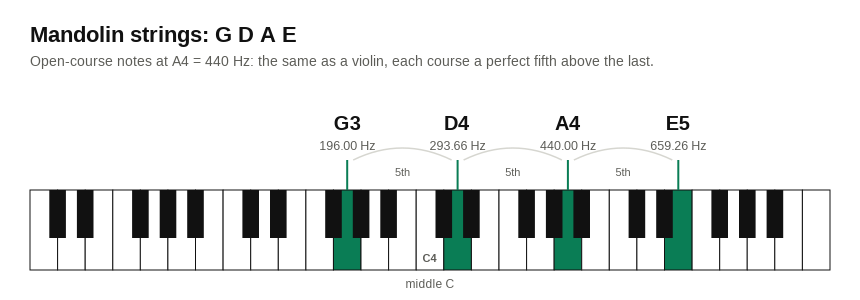
| Course | Mandolin | Mandola | Octave mandolin |
|---|---|---|---|
| 4th (lowest) | G3 196.00 Hz | C3 130.81 Hz | G2 98.00 Hz |
| 3rd | D4 293.66 Hz | G3 196.00 Hz | D3 146.83 Hz |
| 2nd | A4 440.00 Hz | D4 293.66 Hz | A3 220.00 Hz |
| 1st (highest) | E5 659.26 Hz | A4 440.00 Hz | E4 329.63 Hz |
Because the tuning matches the violin, every fiddle tune and violin fingering works on the mandolin, which is a big reason it’s so popular in bluegrass, folk and Irish music.
How to tune a mandolin step by step
- Check the bridge. Mandolin bridges float, held in place by string pressure. Make sure it hasn’t shifted and stands straight before you tune.
- Start with the A course or the G course, then work across. Tune one string of a pair at a time, muting its partner.
- Turn the tuners gently. The thin E strings break easily. Come up to the note from below for better stability.
- Match the pairs. Play both strings of a course together. A slow wobble or “beating” means they’re slightly apart; adjust one string until the sound is smooth.
- Recheck all four courses. Tuning one pair changes the tension on the others slightly.
How to tune a mandolin by ear
Once one course is right, you can tune the rest with the 7th fret, because the mandolin is tuned in fifths:
- G course at the 7th fret matches the open D course.
- D course at the 7th fret matches the open A course.
- A course at the 7th fret matches the open E course.
Listen for the wobble between the fretted and open notes and adjust until it disappears. Use Play reference tone above if you need a starting A.
Why your mandolin goes out of tune
Mandolins carry high string tension on a small body, so temperature and humidity changes quickly affect pitch. New strings stretch for a few days, and with eight of them there’s a lot to settle. A moved bridge won’t change the open-string reading much, but it makes fretted notes sound off, so check the bridge whenever chords sound sour higher up the neck.
Tips for accurate readings
- Tune one string of each pair at a time. Two slightly different strings sounding together can make the needle wobble.
- Pick firmly and read just after the attack. Mandolin notes decay quickly.
- Get close. Hold the phone near the sound hole in a quiet room.
Frequently asked questions
What are the notes of the mandolin strings?
A mandolin is tuned G D A E, the same as a violin: G3 (196.00 Hz), D4 (293.66 Hz), A4 (440.00 Hz) and E5 (659.26 Hz), from the lowest to the highest course. Each course has two strings tuned to the same note.
Why does a mandolin have 8 strings?
The 8 strings are arranged in 4 pairs called courses. Both strings in a course are tuned to the same note and played together, which makes the mandolin louder and gives it its shimmering tone.
How do I tune both strings in a pair?
Tune one string of the pair with the tuner while lightly muting the other, then tune the second string the same way. Finally play both together: if you hear a slow wobble, adjust the second string until the wobble disappears.
Is mandolin tuning the same as violin tuning?
Yes. Mandolin and violin share the same notes, G D A E, so violin fingerings and fiddle tunes transfer directly to the mandolin. The mandolin has frets and paired strings, while the violin is bowed and fretless.
How is a mandola tuned?
A mandola is tuned C G D A (C3, G3, D4, A4), a fifth below the mandolin and the same as a viola. An octave mandolin is tuned G D A E an octave below the mandolin (G2, D3, A3, E4).
Why does my mandolin sound out of tune even after tuning?
The two strings of a course may be slightly apart, or the floating bridge may have moved, which affects intonation up the neck. Check both strings in each pair and make sure the bridge sits in the right place and stands straight.