How to use the double bass tuner
- Press Start tuning and allow microphone access. Place your phone or laptop close to the f-holes; low notes need a close microphone.
- Choose Orchestral, Solo or 5-string in the Tuning menu.
- Bow or pluck one open string firmly and let it ring. The tuner detects the string and moves the needle.
- Needle left: flat, tighten the string. Needle right: sharp, loosen it. When the note turns green, the string is in tune.
Standard double bass tuning: E A D G
Unlike the violin, viola and cello, which are tuned in fifths, the double bass is tuned in fourths: E1, A1, D2 and G2. Fourths keep the notes within reach of the hand on the bass’s long string length. The tuning is the same as a 4-string bass guitar, and an octave below the lowest four strings of a guitar.
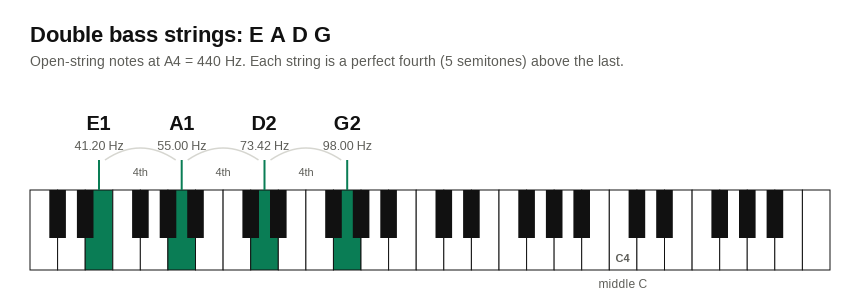
| String | Orchestral | Solo |
|---|---|---|
| 5th (5-string basses) | B0 30.87 Hz | n/a |
| 4th (lowest) | E1 41.20 Hz | F♯1 46.25 Hz |
| 3rd | A1 55.00 Hz | B1 61.74 Hz |
| 2nd | D2 73.42 Hz | E2 82.41 Hz |
| 1st (highest) | G2 98.00 Hz | A2 110.00 Hz |
Bass parts are written an octave higher than they sound, so the open E string is written as the E on the first ledger line below the bass clef staff.
Orchestral, solo and 5-string tuning
Orchestral tuning
The standard for orchestras, jazz and most teaching. Use heavier orchestral strings.
Solo tuning
Every string goes up a whole tone to F♯ B E A. It needs lighter solo strings; tuning orchestral strings up a tone adds a lot of tension. Solo repertoire is normally written in orchestral pitch, so music sounds a tone higher than written.
5-string bass
Many orchestral players add a low B string (B0, about 31 Hz) to reach the low notes in Romantic and modern repertoire. Others use a C extension on the E string instead.
How to tune a double bass
- Tune the A string first to the reference A, since the orchestra tunes to A.
- Tune D, then G, then E, checking each with the tuner or with harmonics.
- Use the machine heads gently. Bass tuners are geared, so small turns make small changes. Approach the note from below.
- Check the bridge. Big tension changes can pull the bridge forward; keep it upright.
Tuning with harmonics
Bassists often tune by ear with harmonics, because they ring clearly and are easier to hear than the low open strings. Touch the string lightly without pressing it down:
- The harmonic on the A string a quarter of the way up (near where you’d stop D) matches the harmonic on the D string a third of the way up (near where you’d stop A). Both sound A3.
- Use the same pair of positions across E and A, and across D and G.
- Adjust the higher string until the two harmonics ring together without a wobble.
Tips for accurate readings
- Get close. Phone microphones are weak below about 60 Hz. Hold the device near the f-holes.
- Bow with weight, or pluck firmly. A strong fundamental gives a steadier needle.
- Quiet room. Air conditioning and traffic rumble sit in the same low range as the bass.
- Wait for the note to settle. The low strings take a moment to stabilise after the attack.
Frequently asked questions
What are the notes of the double bass strings?
Orchestral double bass tuning is E A D G, from the lowest to the highest string: E1 (41.20 Hz), A1 (55.00 Hz), D2 (73.42 Hz) and G2 (98.00 Hz). The strings are tuned in fourths, like the four lowest strings of a guitar but an octave lower.
What is solo tuning on the double bass?
Solo tuning raises every string a whole tone, to F♯ B E A (F♯1, B1, E2, A2). Solo strings are thinner and brighter, which helps the bass project as a solo instrument. Solo parts are usually written a tone lower than they sound.
How do you tune a double bass with harmonics?
Touch the harmonic a quarter of the way along a lower string (around the D on the A string) and the harmonic a third of the way along the next string up; both sound the same note, two octaves above the lower string. Adjust the higher string until the two harmonics ring without beating.
Why can’t the tuner hear my low E string?
The low E is only 41 Hz, near the bottom of what phone and laptop microphones pick up well. Bow with a full stroke or pluck firmly, place the device close to the f-holes, and tap the E string button to lock the tuner to it. The tuner also recognises the string from its first overtone.
Is the double bass tuned the same as a bass guitar?
Yes. In orchestral tuning both are E A D G at the same pitch, and a 5-string bass guitar and a 5-string double bass both commonly add a low B (B0, 30.87 Hz).